
Berks County Court Overview
Berks County is Pennsylvania's 23rd Judicial District. The county trial court is the Court of Common Pleas, which handles major civil, criminal, family, juvenile, and Orphans' Court matters. Appeals generally go to the Pennsylvania Superior Court or Commonwealth Court depending on case type, with discretionary review in the Supreme Court of Pennsylvania.
The main courthouse is the Berks County Courthouse at 633 Court Street, Reading, PA 19601. The Pennsylvania UJS Berks County page lists the courthouse phone as 610-478-6208 and hours Monday-Friday, 8 a.m. to 5 p.m. Court-related offices at or tied to the same address include the Prothonotary, Clerk of Courts, Sheriff, Public Defender, Special Courts Administration, Register of Wills, and Orphans' Court.
The county's Court of Common Pleas page is the official local court source for Berks County trial court information.
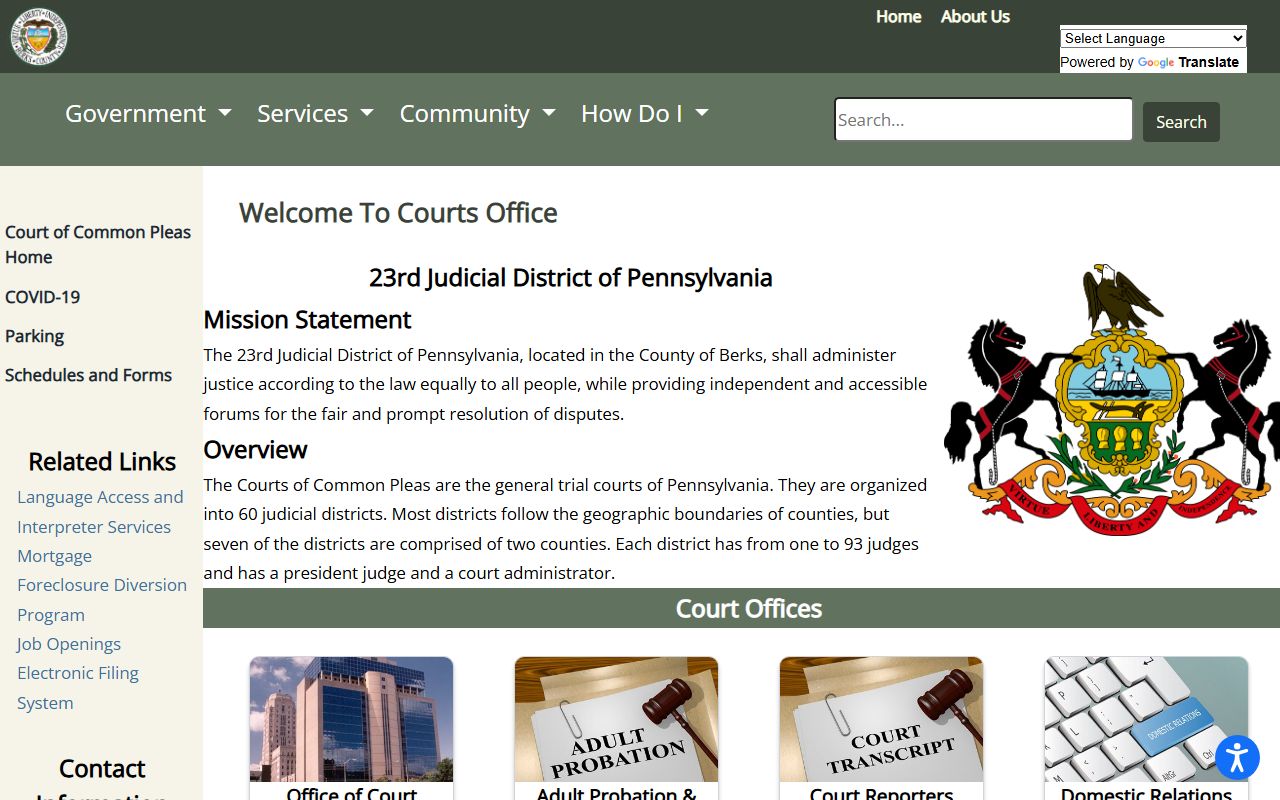
That source connects local court users to common pleas information and public criminal docket access.
Berks County MDJ Table
Berks County has seventeen magisterial district judges and two centralized magisterial district courts under the President Judge. Magisterial District Courts are lower courts, but they are essential to the common pleas case path because they handle summary traffic and non-traffic cases, civil claims under $12,000, landlord-tenant cases, preliminary hearings in misdemeanor and felony cases, emergency protective relief, arrest warrants, search warrants, preliminary arraignments, bail, and marriages.
| Court Number | Judge or Label | Address | Phone |
|---|---|---|---|
| MDC 23-0-01 | Central Arraignment Court | 633 Court Street, Reading, PA 19601 | 610-478-6456 |
| MDC 23-1-01 | Ann L. Young | 600 E. Penn Ave. #5, Wernersville, PA 19565 | 610-678-6721 |
| MDC 23-1-02 | Carissa L. Johnson | 1150 Muhlenberg St., Reading, PA 19602 | 610-374-9288 |
| MDC 23-1-03 | Kyley L. Scott | 633 Court Street, Reading, PA 19601 | 610-378-5101 |
| MDC 23-1-05 | Alvin B. Robinson | 633 Court Street, Reading, PA 19601 | 610-373-2127 |
| MDC 23-1-06 | Colleen Dugan Schearer | 3200 Reading Crest Ave., Reading, PA 19605 | 610-929-4440 |
| MDC 23-2-01 | Priscilla Campos | 441 Morgantown Rd., Reading, PA 19611 | 610-375-7101 |
| MDC 23-2-02 | Vacant in listing | 401 Walnut St., Reading, PA 19611 | 610-374-7721 |
| MDC 23-2-03 | Sandra L. Fegley | 6112 Perkiomen Ave., Birdsboro, PA 19508 | 610-779-5137 |
| MDC 23-2-04 | David L. Yoch | 400 E. Wyomissing Ave., Ste. 1, Mohnton, PA 19540 | 610-777-3885 |
| MDC 23-3-01 | Michael D. Kaufman | 321 N. Furnace St., Ste. 180, Birdsboro, PA 19508 | 610-582-8615 |
| MDC 23-3-02 | F. Richard Drumheller | 100 N. Schaeffer St., Ste. 2, Boyertown, PA 19512 | 610-367-2357 |
| MDC 23-3-03 | Steven M. Chieffo | 590 Oley Rd., Oley, PA 19547 | 610-987-3344 |
| MDC 23-3-04 | Gail M. Greth | 110 W. Arch St., Ste. 118, Fleetwood, PA 19522 | 610-944-7202 |
| MDC 23-3-05 | Brian K. Strand | 2739 Bernville Rd., Leesport, PA 19533 | 610-916-4496 |
| MDC 23-3-06 | Kim L. Bagenstose | 61 N. Third St., 2nd Floor, Hamburg, PA 19526 | 610-562-4364 |
| MDC 23-3-07 | Andrea J. Book | 7191 Bernville Rd., Bernville, PA 19506 | 610-488-6224 |
| MDC 23-3-09 | Tonya A. Butler | 2312 Fairmont Ave., Ste. 500, Reading, PA 19605 | 610-373-4424 |
The official Berks County Magisterial District Court listing is the source for the MDJ offices, central courts, addresses, and phone numbers.
Common Pleas vs MDJ Courts
Pennsylvania does not use a county court or justice of the peace structure in the way some states do. In Berks County, the researched comparison is Court of Common Pleas versus Magisterial District Courts, plus local centralized magisterial courts. The distinction controls which office has the docket, which clerk can certify the record, and whether a case is still at the preliminary or summary level.
| Point | Court of Common Pleas | Magisterial District Courts | Central Arraignment / Reading Central Court |
|---|---|---|---|
| Civil scope | Major civil cases, family matters, divorce-related court records, judgments, and common pleas filings | Civil claims under $12,000 and landlord-tenant disputes | Not the main civil filing venue in the research |
| Criminal scope | Misdemeanor and felony cases after lower-court proceedings, pleas, trials, dispositions, sentencing | Preliminary arraignments, preliminary hearings, bail, warrants, summary offenses | After-hours issuing authority and centralized preliminary hearings from Reading districts |
| Traffic and summary cases | May receive appeals or related common pleas activity | Primary venue for summary traffic and non-traffic offenses | Used for specific centralized magisterial functions documented by the county |
| Record custodian | Prothonotary for civil/family; Clerk of Courts for criminal; Register of Wills for Orphans' Court | Each MDJ office for lower-court records, with UJS docket access | Central court offices and UJS docket access |
For the county's own description of lower-court jurisdiction, see the Magisterial District Judge System page.
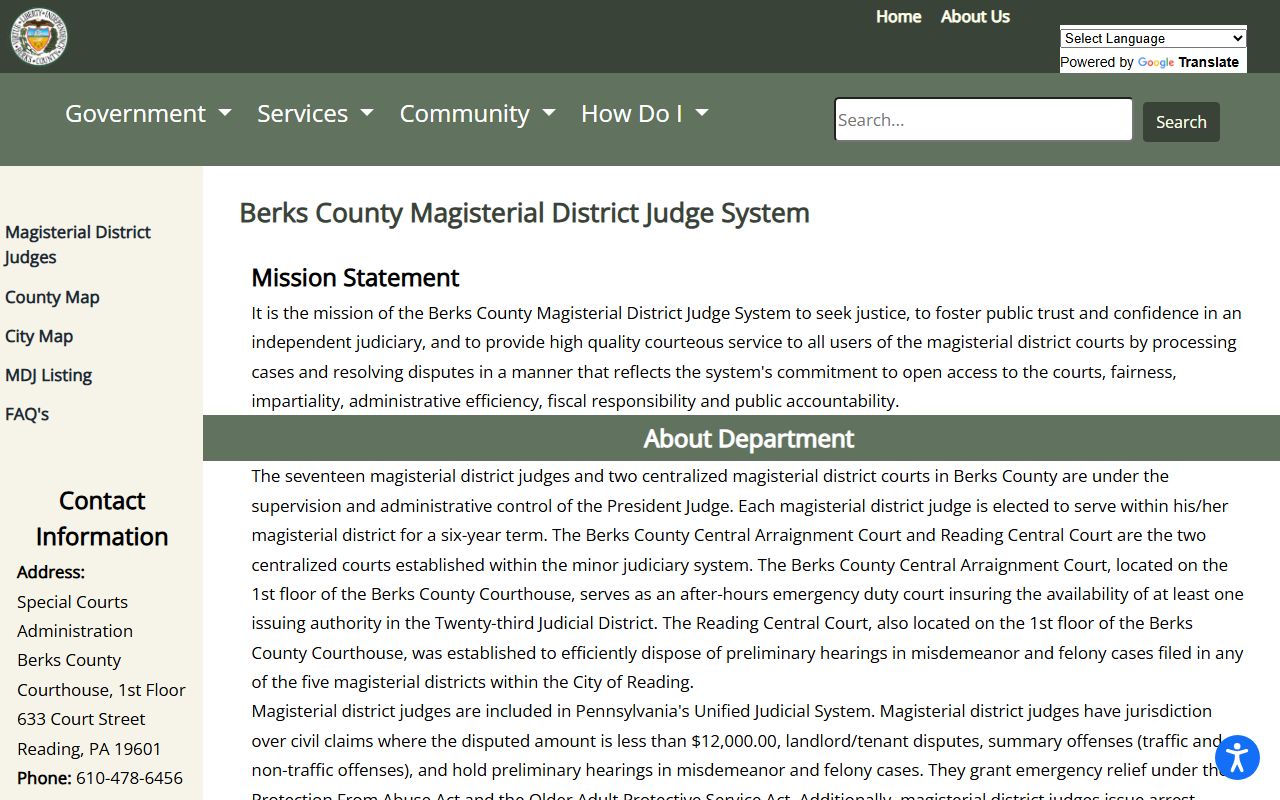
The lower-court page explains why many Berks County criminal, traffic, landlord-tenant, and small civil records begin outside the Court of Common Pleas.
How a Case Moves Through the Berks County System
Case flow depends on record type. Criminal cases often begin with investigation, complaint, warrant or summons, preliminary arraignment, and preliminary hearing before moving to the Court of Common Pleas if held for court. Civil cases filed above the lower-court limit usually begin with the Prothonotary. Smaller civil claims and landlord-tenant cases may begin in a Magisterial District Court.
Criminal flow: MDJ complaint or warrant › preliminary arraignment and bail › preliminary hearing › Court of Common Pleas criminal docket › plea or trial › disposition and sentence › appeal to Superior Court when applicable.
Civil flow: Prothonotary filing or MDJ civil claim › response or hearing › judgment, transfer, or common pleas proceedings › orders and docket entries › appeal when allowed.
Family and Orphans' Court flow: filing with the proper common pleas division or Register of Wills/Clerk of Orphans' Court › docketing › hearing or office review › order, decree, letters, or other disposition.
Civil, Family, and Criminal Divisions
The Court of Common Pleas covers several record paths at 633 Court Street. Civil actions, judgments, liens, name changes, PFA resources, and divorce filings are tied to the Prothonotary. Criminal common pleas records are tied to the Clerk of Courts, including charges, pleas, dispositions, sentences, certified orders, costs, fines, and restitution. Orphans' Court and probate matters are handled through the Register of Wills and Clerk of Orphans' Court.
Family-related work can cross offices. The research identifies Domestic Relations and Family Court as part of the Court of Common Pleas ecosystem for support, divorce-related family matters, custody, PFA, alimony, and marital property division. Some custody, support, juvenile, abuse, and minor information is restricted, so a case may exist without the full file appearing in a public online search.
| Division or Record Type | Primary Berks County Office |
|---|---|
| Civil actions, judgments, divorce filings, PFA resources | Prothonotary, 2nd Floor Courthouse |
| Criminal common pleas records, orders, fines, costs, restitution | Clerk of Courts, 4th Floor Courthouse |
| Probate, wills, estates, guardianships, adoptions, marriage licenses | Register of Wills and Clerk of Orphans' Court, Services Center 2nd Floor |
| Traffic, summary cases, preliminary hearings, warrants, bail | Magisterial District Courts and centralized magisterial courts |
Judicial Circuit / District
Berks County is the 23rd Judicial District. The research identifies the Court of Common Pleas as the county trial court and the Supreme Court of Pennsylvania as the highest state court. Most criminal and civil appeals go to Superior Court. Government and regulatory matters may go to Commonwealth Court. Further review by the Supreme Court is discretionary in many cases.
The UJS county court page is also a practical access point. It links Berks County court information, docket sheets, PAePay, and court resources. Because UJS Case Search includes appellate, common pleas, magisterial district, traffic, citation, attorney, participant, docket-number, OTN, SID, complaint-number, incident-number, parcel, and calendar-event searches, it is the broadest starting point for Berks County trial court records.
The Pennsylvania UJS Berks County court page is the statewide judiciary source for local court address, hours, docket sheets, and PAePay access.
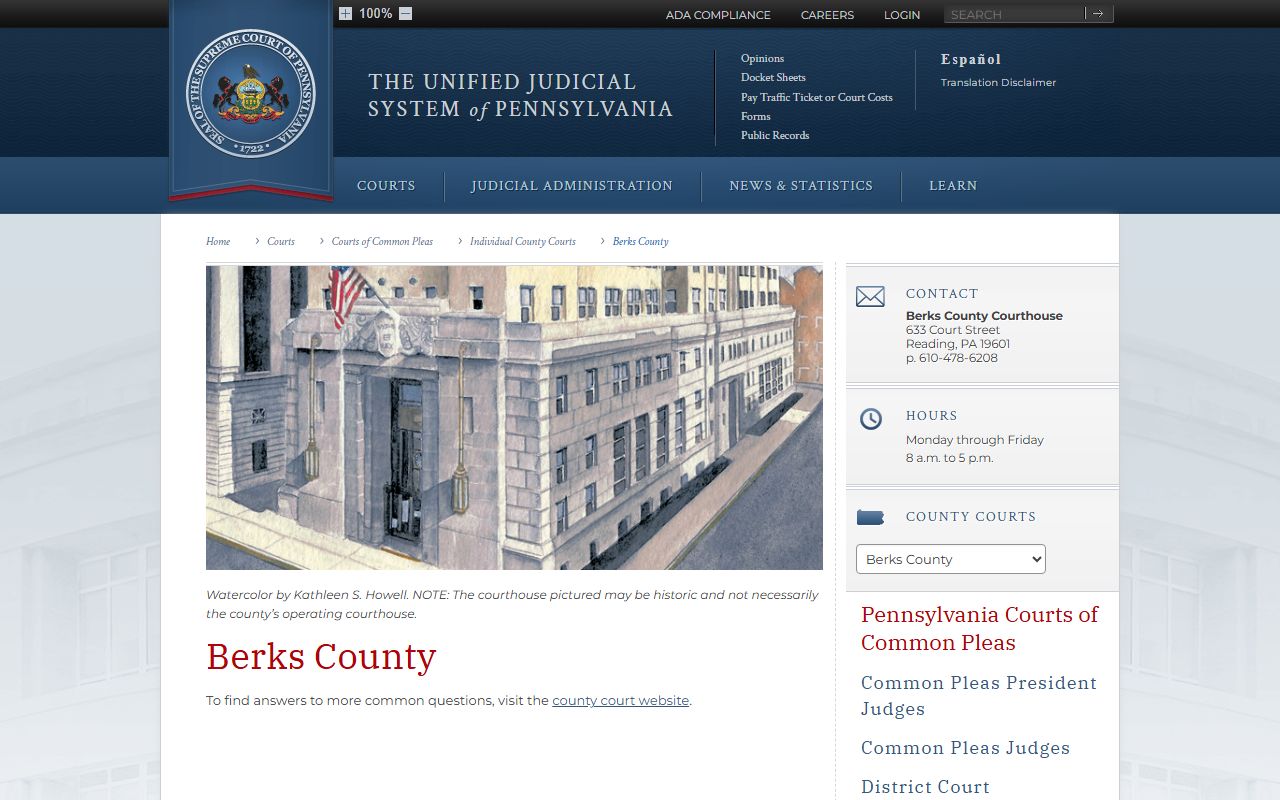
That statewide court page is helpful when a user needs the court directory and the docket or payment tools in the same path.
Magistrate and Lower Courts
Central Arraignment Court is on the 1st floor of the Berks County Courthouse and functions as an after-hours emergency duty court so at least one issuing authority is available. Reading Central Court is also on the 1st floor and was created to handle preliminary hearings efficiently in misdemeanor and felony cases filed in the five Reading magisterial districts.
Magisterial district judges are elected for six-year terms. Their record role is broad: civil claims under $12,000, landlord-tenant disputes, summary traffic and non-traffic offenses, preliminary hearings, emergency PFA and older adult protective service relief, arrest warrants, search warrants, preliminary arraignments, bail, and marriages. For many Berks County cases, the first public docket entry appears at this level before any Court of Common Pleas record exists.
Note: Search UJS first, then contact the specific MDJ office or common pleas clerk that matches the case type.